
KEEP TOURISM WORKING FOR PHILLY
HOTEL TAX & THE TOURISM ECONOMY
Visitor Spending last year generated $417M in tax revenue for the City of Philadelphia – revenue that could be at risk with an increase in the Hotel Tax
$13.4B
IN ANNUAL ECONOMIC IMPACT TO THE GREATER PHILADELPHIA REGION
$417M
IN ANNUAL STATE AND LOCAL TAX REVENUE GENERATED BY VISITOR SPENDING
76,000
LOCAL JOBS
CURRENT TAX RATE
HOTEL TAX 15.5% | PHILA. HOSPITALITY IMPROVEMENT LEVY: .75% | TOTAL TAX: 16.25%
PROPOSED TAX RATE
HOTEL TAX 17.5% | PHILA. HOSPITALITY IMPROVEMENT LEVY: .75% | TOTAL TAX: 18.25%
Higher taxes deter future hotel investment and suppress the ability of hotels to grow their rates. A hotel tax increase undermines an economic engine that currently saves the average Philadelphia household $620 in annual taxes.
NOT JUST A TAX ON VISITORS
THE DOWNSIDES OF A TAX INCREASE

Philadelphia’s Competitive Position:
A loss in competitiveness puts at risk the $13.4B in economic impact the hospitality industry had on the Philadelphia region in 2025.
Loss of Major Events and Future Bids:
This business tax increase will hurt future convention and event business, including the bid to host the 2028 DNC.
Major events are booked years in advance with contracts that allow organizers to go back and renegotiate terms in the event of financial changes.
Local Jobs and Workforce:
The hospitality industry directly supports over 76,000 jobs in Philadelphia—accounting for 10% of all jobs held by city residents. A tax increase puts thousands of workers in every ZIP code at risk for job loss.
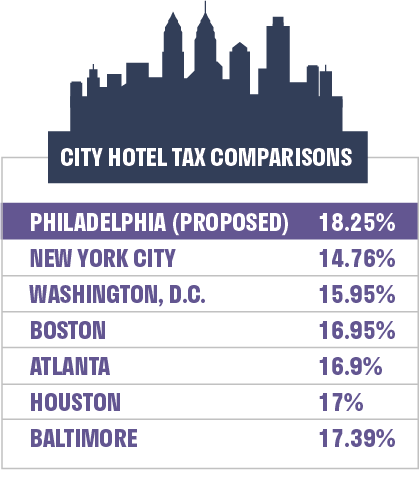
Higher taxes deter future hotel investment and suppress the ability of hotels to grow their rates. A hotel tax increase undermines an economic engine that currently saves the average Philadelphia household $620 in annual taxes.
NOT JUST A TAX ON VISITORS


Mayor Parker has proposed a 2% hotel tax increase to generate funds to support the addition of 1,000 beds with wrap-around services to the city’s shelter system with the goal of ending street homelessness.
ENDING STREET HOMELESSNESS
The hospitality and tourism industry is in full support of the mayor’s goal to end street homelessness, but there are more effective and efficient solutions to address this issue — without risking billions of dollars in economic impact and reducing Philadelphia’s competitiveness in attracting visitors.
Previous increases in the state sales tax specifically exempted hotels because of the potential for negative economic impacts.
The hospitality industry has already demonstrated leadership through PHLCares, a public-private partnership initiative that has raised over $2 million for housing-first solutions since 2019.
SCALABLE SUCCESS
PHLCares in partnership with the Salvation Army recently opened the Hope 220 facility in Center City, providing 92 beds for the unhoused. This efficient model could be replicated to support the achievement of the Mayor’s goal of 1,000 beds without the need for a new tax.
COLLABORATIVE PLANNING
Rather than a business tax, the industry proposes a partnership to test the efficacy of approaches, ensuring resources are spent effectively for a population in varied stages of readiness for assistance.
SHARED CIVIC RESPONSIBILITY
A sustainable solution to citywide challenges should reflect the collective responsibility of the entire corporate community, rather than a targeted tax on a single recovering sector.
A BETTER SOLUTION
FAQS
1. Why should City Council care about this? Will they even need to vote for the tax since it can be struck down at the state level?
Because Philadelphia's hotel tax is governed by state statute, any increase will require enabling legislation from the Pennsylvania General Assembly before it can be implemented. Yet, the legislative process in Harrisburg typically requires the City to demonstrate its own commitment first. That means Council may be asked to vote on this increase before the state has weighed in.
All legislators should care about the negative impact of this tax because it puts the economic wellbeing of the city in jeopardy.
2. What is the timeline for this proposed increase?
While likely unfeasible, the proposed tax increase is set to go into effect in August 2026. However, it will require state enabling legislation to move forward. Even if the tax will go into effect after the majority of large events for 2026 pass, the negative impact of the headlines making national news puts Philadelphia in a negative spotlight during an important year.
3. Does the hospitality and tourism industry care about ending street homelessness?
YES! The industry has been proactive in addressing the homelessness crisis in Philadelphia. In 2019, the PA Convention Center Authority launched PHL Cares—a high-impact, business-led initiative that mobilizes private-sector resources and leadership to help address homelessness across Philadelphia. While our industry is focused on driving visitation and economic growth, we are equally committed to the well-being of all Philadelphians. Through PHL Cares, we helped open 92 beds this year at the Hope 220 facility. We believe this collaborative, public-private model is both scalable and replicable, and can play a significant role in helping the Parker Administration achieve its goal of 1,000 new beds—without the need for additional taxation.